Protecting Business Continuity
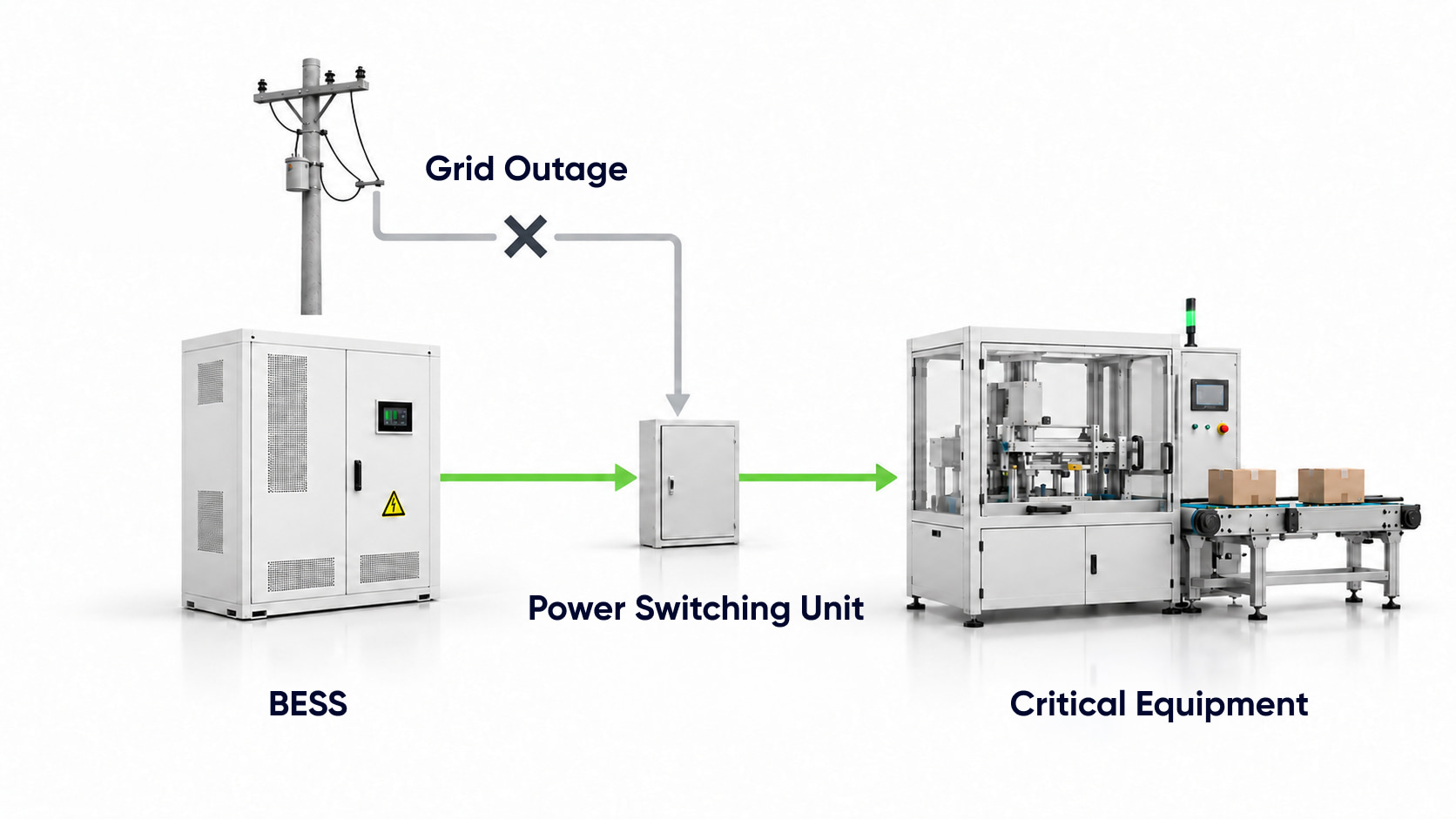
1. Backup Power During Outages
An ESS can supply either all of a company’s loads or a predefined set of critical loads, such as cold rooms, pumps, communication systems, server rooms, checkout systems, automation equipment or part of a production line. When the external grid goes down, a properly designed system provides local power with a defined transfer time.
Where the value comes from: reducing losses caused by downtime or interrupted processes, lost production, cancelled orders and restart costs. For a facility where downtime is expensive, this may be more valuable than daily savings on electricity tariffs.
Who it suits: manufacturing and processing companies, logistics businesses, hotels, retailers and service businesses for which an interruption to processes or business operations is critical. The project requires a list of critical loads, their peak demand, the maximum acceptable interruption and the desired backup duration. The financial assessment should be based on the marginal loss caused by downtime rather than the company’s entire revenue.
2. Protecting Processes That Cannot Tolerate Interruptions
Some equipment stops even during a brief loss of voltage. The objective here is not only to have stored energy available, but also to provide uninterrupted power. The ESS may need to be combined with a separate UPS or a dedicated fast-transfer system.
Where the value comes from: fewer emergency shutdowns, defects and restarts.
Who it suits: automated production lines, server rooms, CNC machines, laboratories, hospitals and critical control systems.
The specified transfer time must be verified for the complete configuration and the specific load. A standard grid-connected ESS should not automatically be treated as an online UPS, which is a separate system designed to maintain an uninterrupted power supply.
3. Reducing Diesel Generator Costs
In a solar power plant + ESS + generator configuration, the battery can absorb surplus solar energy, cover short peaks and supply light loads when starting the generator would be inefficient. The control system coordinates all energy sources.
Where the value comes from: lower fuel consumption, fewer operating hours and lower maintenance costs.
Who it suits: facilities with prolonged outages, seasonal production sites and remote complexes. Such combinations are used in microgrid projects, including those described by the U.S. Department of Energy.
Savings should be calculated using the generator’s actual fuel-consumption curve. Charging the battery from the diesel generator creates losses; it is justified only when improved generator operation and other benefits offset those losses.
Reducing Electricity Costs
4. Using More of the Company’s Own Solar Energy
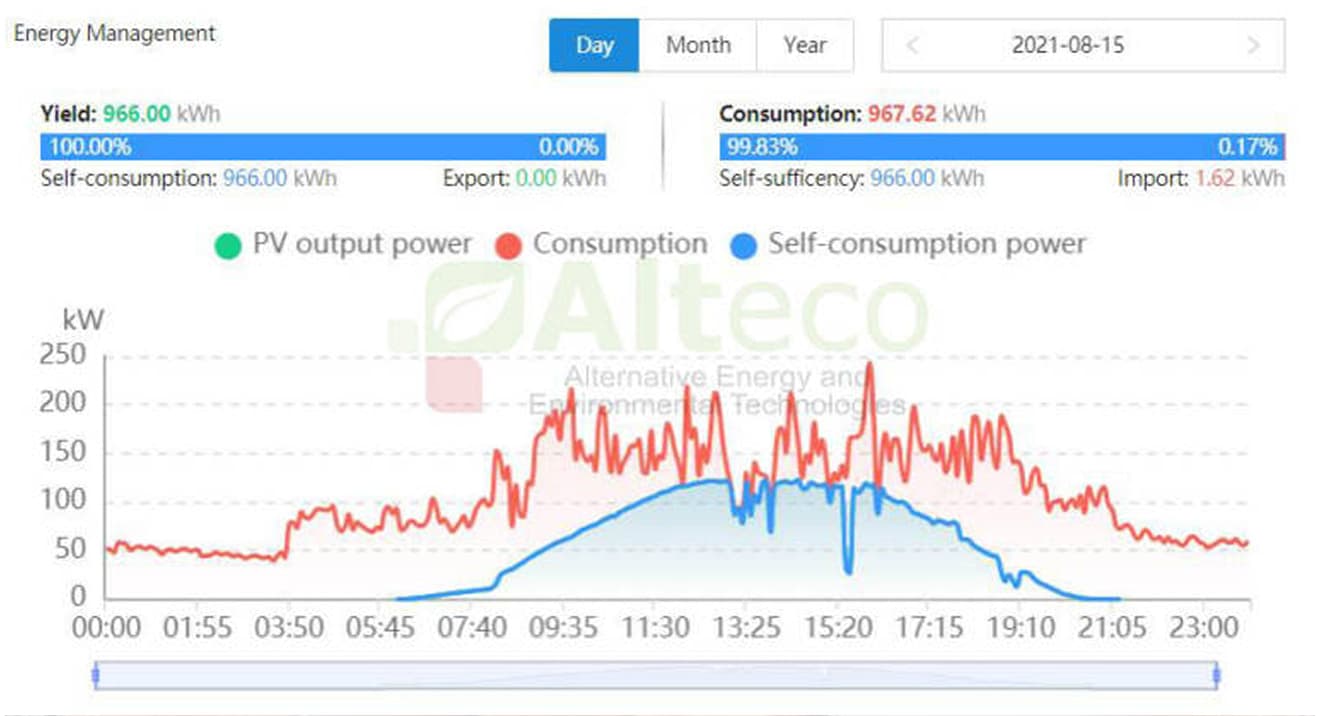
When the solar power plant generates more electricity than the facility consumes, the ESS stores the surplus and supplies it later, for example during an evening shift. This can reduce electricity purchases from the grid. Shifting solar generation into the evening is one of the fundamental applications of solar-plus-storage.
Where the value comes from: the value of avoided electricity purchases, minus the lost revenue from a potential sale of the surplus, system losses and battery degradation.
Who it suits: companies with their own solar power plants and a mismatch between generation and consumption profiles.
The assessment should begin with an analysis of surplus generation. If the company already consumes almost all of the solar plant’s output directly, a battery may add little value under this particular application.
5. Storing Energy the Solar Power Plant Would Otherwise Not Generate
Where exports are prohibited or subject to a limit, the system may be forced to curtail generation. An ESS can absorb part of this potential output if it has sufficient available capacity and charging power.
This differs from simply shifting an existing surplus: it recovers energy that would otherwise be lost through curtailment.
Who it suits: zero-export solar plants, facilities with low weekend consumption and plants with confirmed curtailment. The cause and duration of the curtailment must be assessed, along with whether the stored energy can be used later.
Inverter clipping is a separate case. Whether this energy can be captured depends on the system topology: an AC-coupled battery cannot recover a loss that has already occurred upstream.
6. Shifting Electricity Purchases from Expensive Hours to Cheaper Ones
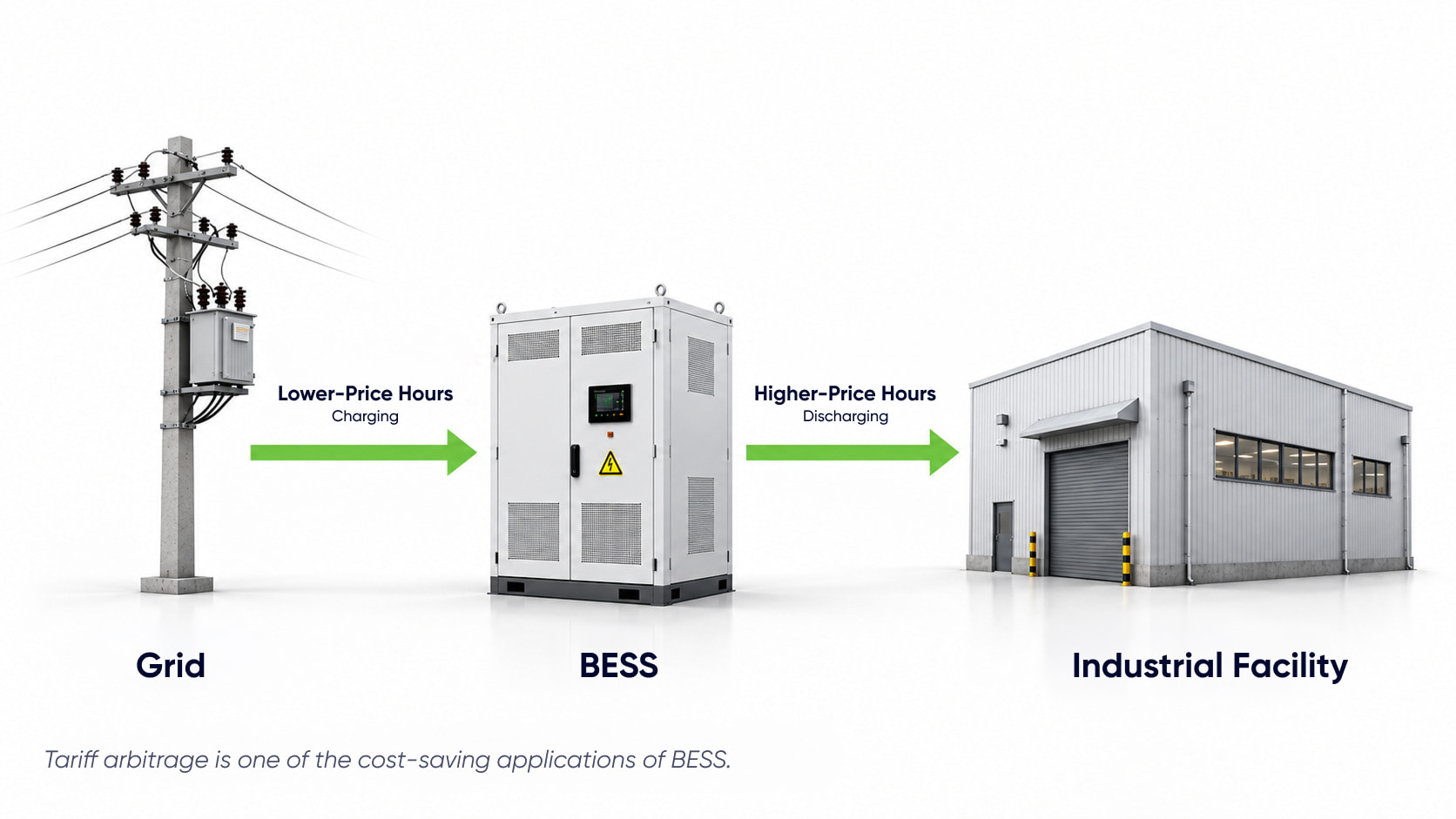
The ESS charges during lower-cost hours and displaces the company’s electricity purchases during more expensive periods. This is tariff optimisation, or arbitrage for self-consumption. Selling electricity to the grid is not required for this application.
Who it suits: businesses whose supply contracts pass time-based price differences through to their actual bills. With a fixed price and no time-of-use differentiation, day-ahead market fluctuations alone do not create such savings. The cheapest hours should be identified from data rather than by assuming that charging should always occur at night.
The calculation requires hourly or more detailed profiles, the supply contract terms and all variable components of the electricity purchase price. The Market Operator publishes hourly statistics, including for 2026. These are input data, not a ready-made payback forecast.
7. Reducing Charges Linked to Maximum Demand
In countries and contracts where part of the bill depends on the measured maximum demand in kW, the battery can lower that maximum through peak shaving. This operating mode can be modelled, for example, in the System Advisor Model.
Condition for Ukraine: the relevant charge must first be identified in your specific contract or bill. If it is absent, savings based on foreign demand-charge rates cannot be claimed. Reducing peak demand may still provide a technical benefit, but that is a different source of value discussed below.
The maximum-demand measurement interval, peak duration and load recurrence are important when sizing the ESS. A brief motor starting current and the measured maximum demand are separate engineering problems.
Expanding a Facility with Limited Grid Capacity
8. Covering a Short-Term Grid Connection Capacity Shortfall
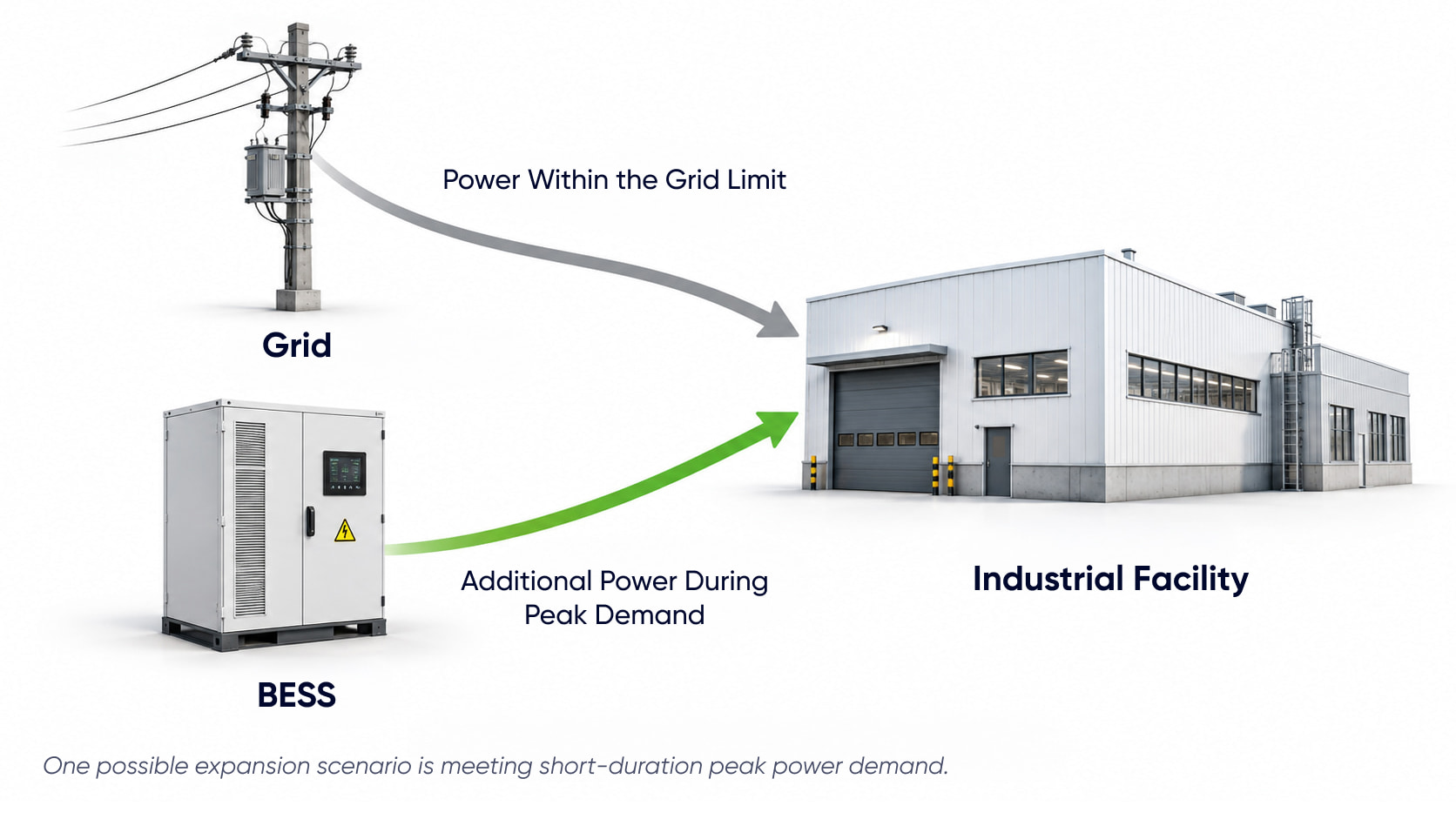
When equipment operates simultaneously, the ESS adds power to the facility’s internal bus and recharges during periods of lower demand. This allows the company to assess an alternative to increasing its connected capacity or to defer part of a grid upgrade.
Where the value comes from: avoided or deferred capital expenditure and the ability to commission a new load sooner.
Who it suits: manufacturing facilities with short peaks, warehouses and shopping centres. This application is covered in studies of the value of energy storage and the deferral of grid investments.
A battery does not change the legally permitted connection capacity. The EMS must keep exchanges with the grid within the agreed limits. If the shortfall lasts for most of the day and there is no time to recharge, an ESS cannot replace an adequate energy source.
9. Fast Charging for Electric Vehicles
The ESS gradually stores energy within the available grid connection capacity and briefly supplies the charging complex with higher power. This architecture makes it possible to consider fast-charging stations at sites with weaker grids.
Where the value comes from: the ability to serve customers, additional charging-business margin and the potential deferral of a grid upgrade.
Who it suits: filling stations, roadside services, hotels, shopping centres and corporate vehicle fleets.
The system is sized according to the number of charging sessions, their concurrency and the total energy required per day. After a series of intensive charging sessions, the battery may be depleted, and the grid will determine the power available for subsequent sessions. The financial model should not add the same grid-connection savings again as a separate benefit under application 8.
10. A Microgrid for a Business or Remote Complex
A microgrid combines on-site generation, an ESS and loads under common control. It can operate in parallel with the grid and, when properly configured, disconnect and supply the facility autonomously. The ESS helps balance variable generation and consumption.
Who it suits: agricultural complexes, remote hotels and manufacturing sites.
Where the value comes from: managed continuity of operations and coordinated use of energy sources.
This is a complex architecture that often includes backup power, solar self-consumption and generator optimisation. These benefits should be calculated within a single model. Island-mode operation, protection systems, motor starting and power restoration must all be verified. A microgrid involving several legal entities also requires a defined legal framework for electricity exchange.
Revenue and Risk Management in the Energy Market
The following applications require a defined market role, contracts and appropriate metering. Balancing and ancillary services also involve specific requirements for controllability and verification of technical characteristics. The engineering solution and market access must be developed together.
11. Energy Arbitrage with Exports to the Grid
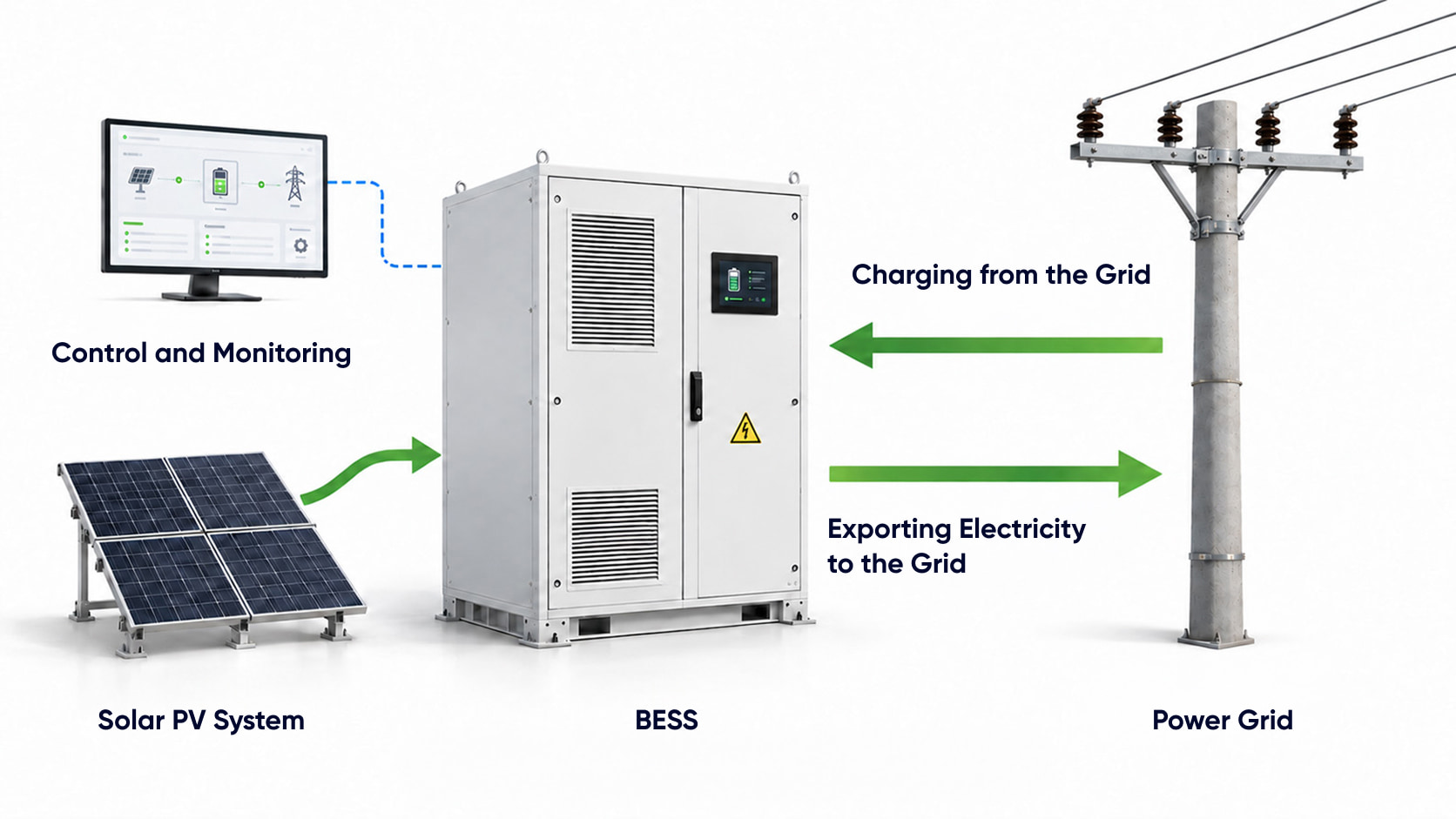
The ESS purchases electricity for charging during low-price hours and sells it during higher-price periods. Unlike application 6, the result is a trading margin rather than simply a lower electricity bill for the company. NREL distinguishes between behind-the-meter systems and market-based storage systems that sell electricity.
Who it suits: investors, ESS operators and owners of sites with sufficient import and export capacity. The calculation must include losses, degradation, fees, imbalances, the cost of capital and the rules of the relevant market segments.
The physical ability to export does not automatically provide access to trading. Participation in the day-ahead and intraday markets is governed separately.
12. Reducing Imbalance Costs
The actual output of a solar power plant or a company’s electricity consumption may deviate from the nominated schedule. An ESS can partly offset these deviations by charging or discharging.
Where the value comes from: lower imbalance settlement costs under the relevant contract.
Who it suits: generators, members of balancing groups and consumers that incur these costs.
This is a matter of managing forecast error, not a guarantee of zero imbalances. The system requires power and energy reserves, a forecast and timely measurements. Following a forecast schedule is identified as a separate application in academic classifications of energy storage business models.
13. Providing Balancing Energy
The ESS changes its import or export in response to commands from the transmission system operator within the market rules. The source of revenue is the balancing energy actually delivered and the corresponding settlement. This differs from correcting the owner’s own imbalances.
This application may be relevant to ESS operators and facilities participating through an aggregator. Its assessment requires the participation terms, technical readiness, remote control, metering and responsibility for following commands. Simply owning a battery does not create an entitlement to this revenue.
14. Ancillary Services and Power System Reserves
A battery can remain ready to change its power output to support the power system, including frequency regulation. Payments for reserved capacity and settlements for activated energy are different in nature. They cannot be combined into a single universal rate per MWh.
Access requires the verification procedures, confirmation of technical characteristics and contracts specified by the market rules. The reserve volume must be consistent with the PCS capabilities, state of charge and product requirements.
Ukraine’s market already has large battery projects: in September 2025, DTEK and Fluence announced the commissioning of a 200 MW / 400 MWh portfolio. This confirms that the technology is being deployed in practice, but it is not a revenue forecast for another investor.
15. Creating a Predictable Renewable Energy Supply Profile
A generation owner can use an ESS to bring exports closer to the schedule agreed with the buyer, for example by shifting part of the daytime output into the evening under a long-term power purchase agreement, or PPA.
Where the value comes from: the commercial value of an agreed supply profile and a reduced need to purchase additional electricity to fulfil the contract. This is a contractual product for the generator and buyer, not a guaranteed price premium.
A few hours of storage cannot provide round-the-clock supply from a single solar power plant in all weather conditions. Seasonal patterns, backup sources or grid purchases must be considered. IRENA examines the economics of predictable renewable energy supply and the role of storage in its 2026 report.
An Energy System Built Around Your Business Needs
An ESS gives businesses several options: protection against downtime, lower electricity costs, facility expansion where grid capacity is limited, and participation in the energy market. A single system can combine several applications if its power, capacity and control modes are aligned with the company’s needs.
Choosing the right solution begins with a specific objective: what needs backup power, which costs should be reduced, or which new load must be supported. An analysis of consumption, existing generation, grid connection terms and contracts helps determine the ESS configuration and assess the expected result. When combining applications, the shared use of the battery must be considered to avoid double-counting benefits.
From the Selected Application to a Complete System with Alteco
Alteco can provide professional design and construction of an ESS-based energy system for any of the applications discussed. Equipment selection, integration with the grid, solar power plant and backup sources, control-system configuration and commissioning are combined into a single solution tailored to your facility and its operating requirements.
Discuss your company’s needs with the Alteco team to identify suitable ESS applications and the right configuration for your future energy system.