Financing Solar Power Plants and Energy Storage Systems: What Options Are Available to Businesses?
The cost of an industrial energy system depends not only on the capacity of the equipment, but also on the specific features of the company’s electrical network, installation, control systems and required infrastructure. The key question, therefore, is not only how much the project will cost, but also how it will be financed.
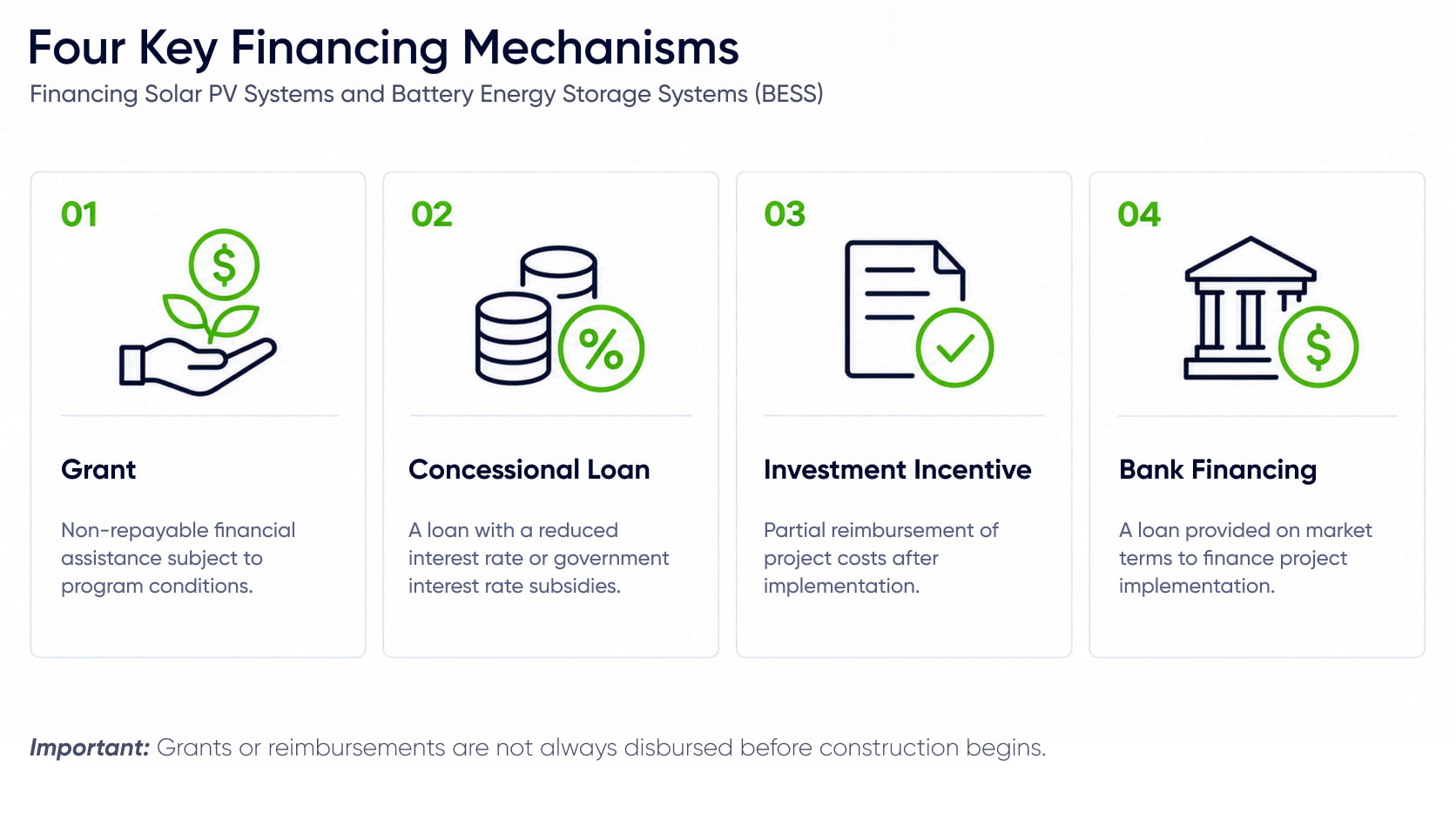
There are four main financing mechanisms:
Grant — non-repayable assistance provided that the programme requirements are met. Calls for applications have defined deadlines and selection criteria.
Concessional loan — a loan at a reduced interest rate, including through government interest subsidies. The principal amount must be repaid.
Investment incentive — support that may reimburse part of the eligible costs once the relevant conditions have been met.
Bank financing — a loan on commercial terms, including for companies that do not qualify for special programmes.
The availability of a grant does not necessarily mean that funds will be received before construction begins. Some mechanisms reimburse costs that have already been incurred. The timing of the funding is therefore just as important as the amount.
Which Financing Programmes Are Available to Ukrainian Businesses?
The choice depends on the size of the company, the cost of the energy system and its intended purpose. Some mechanisms are designed for small and medium-sized businesses, while others apply to major investments.
“Affordable Loans 5–7–9%”: Energy Resilience for Small and Medium-Sized Businesses
A dedicated track under the government programme allows businesses to obtain financing for solar power plants, energy storage systems and other eligible energy equipment.
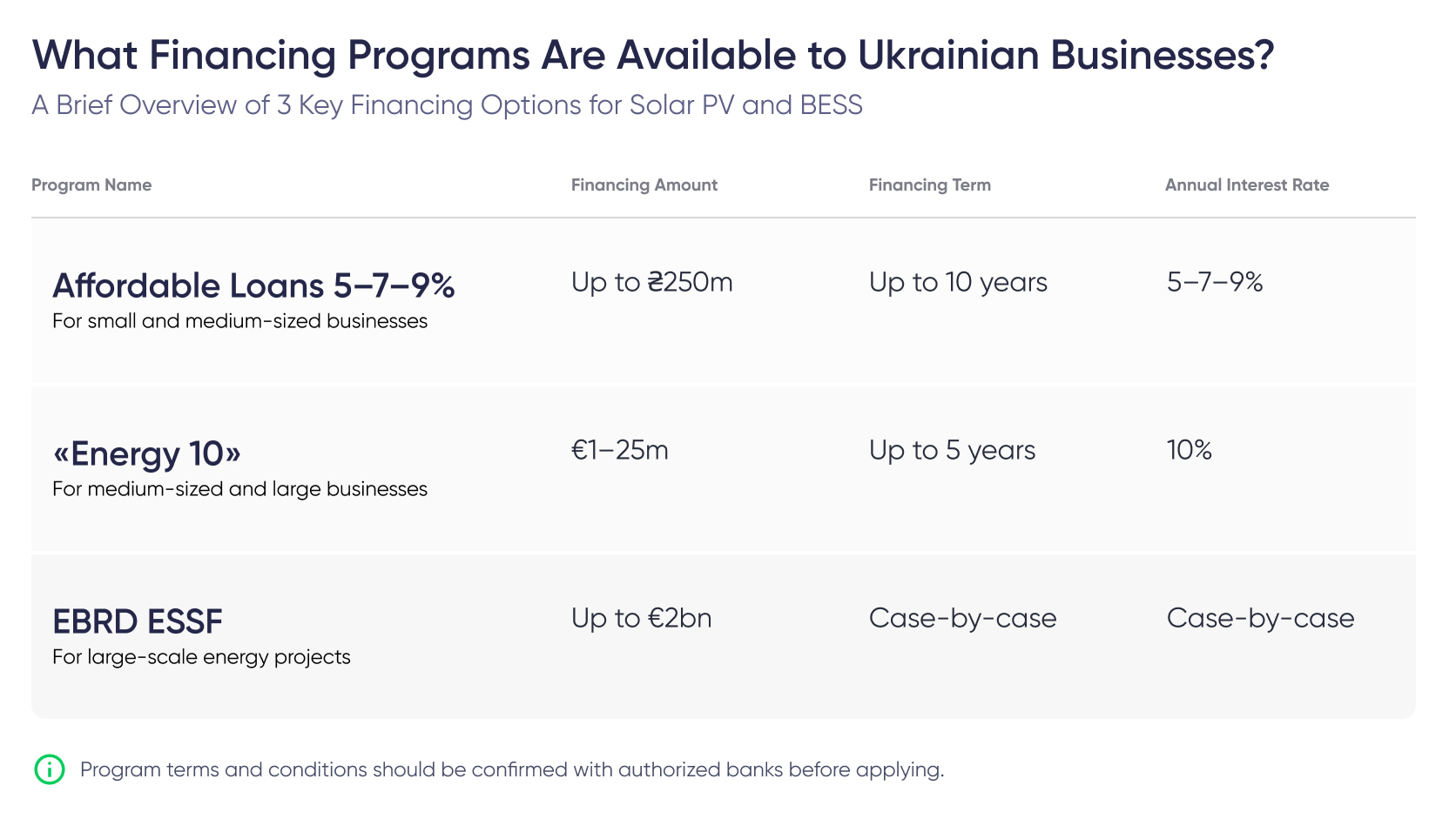
- Amount: up to UAH 250 million.
- Term: up to 10 years.
- Interest rates: 5–9% per year under the programme.
- Eligibility: small and medium-sized businesses that meet the criteria.
Before applying, it is important to verify the company’s category and creditworthiness. Investing in green energy does not in itself guarantee approval.
“Energy-10”: Financing for Large-Scale Projects
The government programme is intended for medium-sized and large businesses developing distributed generation and energy infrastructure.
- Amount: EUR 1 million to EUR 25 million in the hryvnia equivalent; separate terms may apply to frontline regions.
- Interest rate: 10% per year.
- Term: up to 5 years.
- Eligible areas: specified types of generation, energy storage systems, microgrids and energy infrastructure.
Standard solar power plants are not listed separately in the official list of eligible equipment. The eligibility of a specific solar project should therefore be confirmed with an authorised bank rather than assumed.
The selection process assesses both the borrower and the project’s technical readiness. Preliminary calculations and documentation therefore play an important role even before a loan application is submitted.
EBRD ESSF: International Financing for Energy Resilience
The Energy Security Support Facility (ESSF), with total funding of EUR 2 billion, supports solar generation, energy storage and energy efficiency projects through partner banks. This is the facility’s overall budget, not the amount available as a loan to a single company.
The programme is already operating in practice. According to the EBRD, a 7.2 MW solar power plant project in the Zaporizhzhia region secured a UAH 122 million loan against a total project cost of approximately UAH 173.5 million. Another project — a 2 MW / 4 MWh energy storage system — received UAH 51.5 million in loan financing.
Additional investment incentives may be available under certain conditions. However, not every company qualifies for the grant component, so it should not be included in the financial model without confirmation from the bank.
Financing for Alteco Projects Through a Partner Bank
Alteco customers planning an industrial solar power plant or energy storage system can consider the loan and grant programmes offered by our partner bank, ProCredit Bank. This makes it possible to align the technical parameters of the energy system with the financing requirements while the investment is still being planned.
In particular, the EFSE programme offers eligible companies a grant equal to 20% of the investment loan amount for fixed assets, with an additional five percentage points potentially available to certain categories of borrowers. The maximum grant amount is EUR 100,000.
Under the EBRD RLG mechanism, the bank may provide loans backed by a guarantee and, for eligible investments, additional incentives. The terms depend on the borrower category, equipment and project assessment. The guarantee reduces the bank’s credit risk but is not a grant to the company.
Alteco is responsible for preparing the technical solution and calculations covered by its services, while the bank makes the decisions on the loan, grant and final terms. Working with Alteco does not in itself guarantee financing approval or a preferential interest rate.
Why the Lowest Interest Rate Does Not Always Mean the Best Loan
It may seem sufficient to compare interest rates. But a shorter repayment term, a down payment, collateral, fees and insurance can place a significant strain on cash flow even when the interest rate looks attractive.
Not every “energy loan” is suitable for a solar power plant. One separate zero-interest programme, for example, finances specified generation facilities and generators rather than solar panels or energy storage systems.
The price of the equipment is not the entire budget. Design, installation, control systems, grid connection and commissioning must also be taken into account. Not all related expenses are necessarily eligible under a particular programme.
A grant may be paid later. A company may first have to pay for the work with its own or borrowed funds and only then apply for reimbursement.
The comparison should cover not only interest rates, but also the total cost of financing and the effect of payments on the company’s finances.
Even a carefully selected loan, however, does not answer another question: does the energy system itself match the actual needs of the business?
How the Choice of a Solar Power Plant or Energy Storage System Affects Project Economics
If the goal is to reduce electricity bills, a good starting point is a solar power plant sized to match daytime consumption. The more electricity the company uses directly as it is generated, the better the economic outcome may be.
If the main priority is production continuity, a grid-tied solar power plant alone is not enough: without a dedicated backup architecture, it stops operating when grid voltage is lost.
An energy storage system can store energy, manage peak loads, shift consumption between time periods and, when properly configured, support critical processes during outages.
A solar power plant combined with an energy storage system supports several operating scenarios but requires a higher initial investment. The options should therefore be compared based on their effect on the specific company, rather than solely on the equipment included.
How to Prepare a Project for Financing
The bank needs to see not only the price of the plant, but also the cash flows the company will use to service the loan. The technical solution and financial model must therefore be linked.
The process begins with an analysis of hourly electricity consumption, tariffs, the production schedule and the consequences of potential downtime. The next step is to determine the solar plant capacity, the energy storage system parameters, operating modes and the full budget.
The financial model and, where necessary, a feasibility study (FS) should account for capital and operating costs, expected savings, loan payments and several scenarios involving changes in tariffs or load.
The bank may also request financial statements, property documents, a technical concept, a cost estimate and design documentation. The exact set of documents and the need for an additional expert review depend on the programme and are not the same in every case.
Energy Independence Begins with the Right Calculations
A solar power plant or energy storage system is a long-term investment. Its effectiveness depends on the combination of equipment specifications, consumption patterns and financing terms.
The best starting point is therefore not to search for the cheapest loan, but to answer this question: which energy system will deliver the required result for the company, and under what conditions will its implementation be economically viable?